Saturday, June 27, 2015

Censorship and freedom of speech in Venezuela

Authors:
José Alberto López Rafaschieri and Luis Alberto López Rafaschieri
www.morochos.net

This week we were interviewed again by the Ukrainian newspapers, "Politikantrop" (in english) and "Media Sapiens" (in Ukrainian). We spoke with them about the current state of the freedom of speech in Venezuela. These are some quotes from the mentioned conversations:
"Now, Venezuelans use Facebook, Youtube and Twitter to know about events that do not appear in the formal press, for example, riots, political repression and speeches from the alternative politicians. That happened because of a increasing censorship and auto-censorship of the traditional media."

"Then, In the current Venezuelan political context, where the increasing censorship of traditional media is the rule, the use of new methods to deliver information to the public is obligatory, especially, the Information and Communication Technologies, like Internet and smartphones."

"For this government, the suppression of the freedom of speech is one of its main policies to maintain the power."

"The international press has suffered the same difficulties than the Venezuelan media to inform about the events producing here. Journalist Fernando Del Rincon was fired for a moment from CNN due to the pressure the Venezuelan government applied to this TV station. And many international reporters, like Francesca Commissari, have been arrested for covering our civil protests. "


Related articles:

Tuesday, February 25, 2014

"Chavism had never been so weak as now"

Authors:
Luis Alberto López Rafaschieri and José Alberto López Rafaschieri
www.morochos.net

In an interview for two Ukrainian newspapers, "Politikantrop" (in english) and "Third Republic" (in Ukrainian), we spoke about the current Venezuelan political crisis, making a comparison also between this process and that experienced by Ukraine recently. These are some quotes from the mentioned conversations:
"The political unrest in Venezuela was this time caused by economic measures such as a maxi-devaluation of the Venezuelan currency, hardening of exchange rate policy, price controls and judicial persecution of business owners. These policies have promoted the most severe inflation rate of the Chavista era, over 50% last year, and the worst scarcity of basic products in decades. In general, you cannot find milk, cement, bathroom paper, sugar, cooking oil, autoparts, flour, etc. in the Venezuelan markets."
"We have worse problems than those that provoke the fall of previous Venezuelan political elites. Maduro does not have the charisma of Chavez. He is unpopular even among sectors of the ruling party. Chavism had never been so weak as now." 
"In Ukraine, the current administration has a bad record dealing with people problems, the country is polarized between two main groups, and sovereignty is a critical issue. The role of Russia in the breaking of the agreement of Ukraine and the European Union cause discomfort in many sectors.
Certainly, we can encounter similarities, only change Russia for Cuba in our history. The ethnic variable, in Ukraine, is perhaps the most significant difference."


Related articles:

Saturday, July 20, 2013

Symbolic singnificance of 2013 Venezuelan municipal elections

Authors:
José Alberto López Rafaschieri and Luis Alberto López Rafaschieri
www.morochos.net

On December 8 of this year, Venezuelans will choose mayors and local councilors in a nationwide municipal voting. The main significance of this event is that it will be the first election to be held after the technical draw of April 14, when Chavista candidate, Nicolás Maduro Moros, defeated Henrique Capriles Radonski 50,61% to 49,12%.

After that election, the group who attracts the most votes in the municipal electoral process will demonstrate to Venezuela and the world who represents the political majority in this South American country, giving, also, a popular evaluation of the president and opposition during the last months.

The uncontrolled rise in crime, inflation and commodities shortages will impact the vote for the party of Maduro, PSUV, but the contradictory position of Capriles, that is, inciting a popular uprising against the April elections results, and call now to participate in the municipal voting without pressing for any modification to the electoral system, will have also consequences on the vote for the opposition parties.


Related articles:

Saturday, April 20, 2013

The repression in Venezuela after the presidential election

Authors:
José Alberto López Rafaschieri and Luis Alberto López Rafaschieri
www.morochos.net

In the protests following the Venezuelan presidential elections of April 14, we highlight some topics about the government procedures to maintain the order:

1. The authorities primarily sent paramilitary forces of the ruling party to combat the street demonstrations, making the violence worse.

2. The government arrested several protesters and entered into his homes without following legal procedures. Also, PSUV politicians exercised pressure on the independent press to retain the censorship, specially, this time, in TV stations like Televen and Globovision.

3. The official reports about the situation included murders from other cases (crime, personal problems, etc.) and unverified attacks to public services installations, with the aim of demonizing the protests.

These elements show a government that use methods not approved by the human rights conventions.  We have pronouncements of the international community supporting the election of the new Venezuela's president, Nicolas Maduro, but we haven't any mention of this illegal use of force and lies against civilians.


Related articles:

Thursday, February 21, 2013

"No immediate pro-democratic change in Venezuela"

Authors:
José Alberto López Rafaschieri and Luis Alberto López Rafaschieri
www.morochos.net


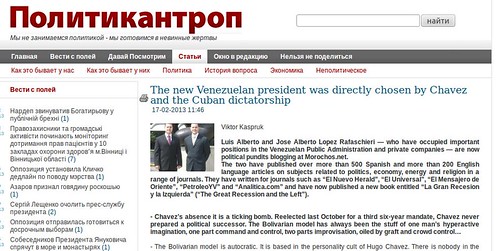
Politikantrop published and interview in which the Ukrainian political scientist and journalist, Viktor Kaspruk, spoke with us about the current Venezuelan politics. You can read the entire publication by clicking here.

These are some fragments of the interview:
"The Bolivarian model is autocratic. It is based in the personality cult of Hugo Chavez. There is nobody in the government with the leadership to carry on the “revolution”. That will be the principal obstacle in the futures plans of the chavista elite."
"Chavismo will continue censoring the independent media and nationalizing companies. Since its arrival, the Bolivarian Revolution has not stopped expropriations, and today, the remaining private media are exposed to content controls, fiscal pressures, foreign exchange privileges and other forms of covered coercion."
"We see no reasons to believe in an immediate pro-democratic change if Hugo Chavez leave the presidency. The Venezuelan economy is now growing more than 5%, the government party (PSUV) controls every public institution, the majority of newspapers, TV and radio stations have adopted an accommodative bias, and the most important opposition political parties are beginning to do the same."

Related articles:

Friday, September 21, 2012

Chavista mismanagement: New source of risk for oil market

Authors:
José Alberto López Rafaschieri and Luis Alberto López Rafaschieri
www.morochos.net

Political instability in Middle East, a terrorist attack in Nigeria or Colombia, and a nationalization process in some part of Latin America are the classic problems that confront the international oil production.

However, in Venezuela, the Chavez government has introduced a new way to frequently disrupt the world oil supply: incompetence.

One day is an explosion in one of the Venezuelan oil company refineries because nobody noticed the high gas levels in the facilities, as happened recently in the Amuay installations.

Some days later, other PDVSA oil tank explodes because his managers took no precautions against thunderstorms, like lighting rod systems, as occurred in El Palito oil facility.

Since 2002, PDVSA has had at least 38 accidents related to incompetence: oil well fires (Cardon cases for example), explosions, tanker crashes, offshore platforms subsidences, workers' deaths due to faulty safety measures, etc.

The next time oil analysts search for risk in the international oil market, they should consider, too, which PDVSA workers are not qualified to do their job. Chavista mismanagement in the Venezuelan oil industry has not ended.


Related articles:

Friday, July 20, 2012

Chavez near Pinochet's record

Authors:
José Alberto López Rafaschieri and Luis Alberto López Rafaschieri
www.morochos.net

Augusto Pinochet was the head of the Chilean government for nearly 17 years, one of the longest authoritarian regimes in Latin America. The South American general surpassed in duration others of his class, as Marcos Perez Jimenez and Alberto Fujimori.

President Hugo Chavez's government has 14-year in power, after two presidential terms. If he wins a third time, his regime would add 72 months more, for a total of 20 years, with the potential to extend for longer, thanks to the constitutional reform promoted by Chavez to establish unlimited reelection.

A third term would put Chavez over Pinochet in the sub-continental ranking of authoritarian governments that have lasted longer. Since then, he would be following in the footsteps of Trujillo and Castro.


Related articles:

Saturday, May 26, 2012

Lower oil prices are good, but for whom?

Authors:
José Alberto López Rafaschieri and Luis Alberto López Rafaschieri
www.morochos.net

"High oil prices pose a real threat to the global economic recovery", told the International Energy Agency (IEA) recently, but it depends on the point of view. From the industrialized countries to the Third World, oil is essential for development. The problem is that this natural resource is the main source of national income for the regions that have it, mostly poor countries.

The IEA aspiration of low oil prices means more poverty for nations like Ecuador or Nigeria, and more benefits for the Group of Eight and China, the world's largest importers. That is, funding the growth of rich nations, or the "global economy recovery", at the expense of countries with high rates of poverty.

At this moment, something that really would benefit the global economy recovery is to lower the interest rates applied to loans of developing countries. That could help a lot in Greece, Africa, Asia and Latin America.

In the same manner, the technology produced in the rich countries can be sell with discount to the Third World in an selfless gesture, pulling millions out of poverty. Ah, but that is a price for the global economy recovery that the most powerful nations are not willing to pay. It is most easy if the oil producers sell at lower prices.

Everybody wants a good price for his products, whether are natural resources, money or technology. In this oil price controversy, why not apply the same standards used in the technology and financial markets? We should let the supply/demand forces set a fair price to crude oil and its derivatives, without political pressures, as happens with industrialized countries' goods.


Related articles:

Tuesday, April 17, 2012

From Günter Grass to "Ozzie" Guillen

Authors:
José Alberto López Rafaschieri and Luis Alberto López Rafaschieri
www.morochos.net

We support the Jews people on many issues, and we are critics of the Cuban dictatorship and the Iranian regime. However, we are dissatisfied with the sanctions applied to Günter Grass and Oswaldo Guillen for their remarks about Middle East and Cuba.

How would we react if a Cuban baseball manager were punished for expressing his admiration for Barack Obama, or if an Iranian intellectual were isolated for his opinions?

What was the crime of these men? Grass' poem, "What must be said", is a civic approach on international politics. And the words of Guillen on Castro, for us, are the result of recklessness. We can not agree with these remarks, but that is no reason to apply sanctions to them.

It is unthinkable to suspend a person from his position as manager for expressing his political belief. It is extreme to pretend to withdraw the Nobel prize to Grass, and declare him persona non grata in Israel, for writing his views about Middle East peace. The message for our society is: when someone says something with which you disagree, punish him.

Accepting these sanctions weakens our critics against repressive political systems for their intolerance and persecution of dissent. Even if we assume they said misconceptions, what should we do? In democracy, having an opinion is not a crime. We can object any idea, but to apply penalties against those who think differently is uncivilized and backward.


Related articles:

Saturday, March 17, 2012

Polls for Venezuela's presidential election

Authors:
José Alberto López Rafaschieri and Luis Alberto López Rafaschieri
www.morochos.net

There will be presidential election in Venezuela on October 7. In this race, Hugo Chavez Frias, representing the incumbent party, will compete against Henrique Capriles Radonsky, the opposition's candidate.

The first public opinion reports about this election show that the current president has a considerable advantage over his opponent. According to a study of IVAD, mid-February, Chavez has 57.7% of voting intention, while Capriles holds 29,9%. Similar results found International Consulting Services, who said late February that Chavez has 58,7% and Capriles 25,7%.

In March, the measurements of Hinterlaces and Consultores 30.11 do not differ either from those presented above. Hinterlaces shows Chavez and Capriles with 52% and 34% respectively, and Consultores 30.11 with 57,5% and 26.6%.

It should be noted, however, that previous reports of these organizations have been wrong on several past elections. For example, IVAD and Datanálisis said the government was going to obtain more votes than the opposition in the parliamentary elections of 2010; and Hinterlaces claimed, also in 2010, that the PPT would become one of the main Venezuelan political parties, due to the high vote it would receive in the legislative elections.

03-22-2012: Consultores 21: Chávez 45%, Capriles 46%.


Related articles:

Friday, March 2, 2012

Venezuela: Capriles or the uncertainty?

Authors:
José Alberto López Rafaschieri and Luis Alberto López Rafaschieri
www.morochos.net

Will Hugo Chavez remain in power until the presidential elections? How sick is he? Is there someone in his party that can replace him? Can he make a successful campaign under such conditions? There will be presidential elections on October 7? What can happen in Venezuela if Chavez dies? At this moment, no one can provide that information, considering we are talking about a regime that claims to be an example of democracy for the world.

The coming months will be hard to foresee in Venezuela. If Chavez returns from this new hospitalization, he will announce that this time it's all over, but no one will believe him because he said the same thing the first time. His return will only increase the rumors that his illness is terminal or that is part of an unscrupulous electoral strategy, adding further doubts to the atmosphere of misinformation.

If there are elections in October, and Chavez wins, no one can say how long he can stay in charge, that is, not even a hypothetical victory of the Bolivarian Revolution leader in the upcoming elections will end the confusion in Venezuela.

And if he dies or appoints a successor, before or after the elections, the unity of the ruling party will be tested. The acting president would have neither the charisma nor the authority of his predecessor to maintain the internal cohesion, and we do not know the risky scenarios in which the country could enter.

A victory of the opposition's candidate, Henrique Capriles Radonsky, would be the solution to these labyrinths. His government will confront surely a hard instability period at the beginning, but maybe it will be the most reliable option in the medium term.


Related articles:

Thursday, February 16, 2012

Venezuela-USA relations and Chavez's new Defense Minister

Authors:
José Alberto López Rafaschieri and Luis Alberto López Rafaschieri
www.morochos.net

Chavez names new Defense Minister a man that is being accused by Washington, since 2008, of aiding drug traffickers and arming rebels in neighboring Colombia, a decision that have implications in the domestic politics and in the international sphere.

In this occasion, our interest will be the external side of the designation of General Henry Rangel Silva as Defense Ministry, particularly in the USA-Venezuela relations.

The United States spent millions of dollars, annually, combating illegal drug production and guerrillas in Colombia, two linked issues. Part of this war is the identification of region's government officials that support the groups involved in these criminal activities, and according to the U.S. intelligence services, the mentioned Venezuelan general is one of them.

In that context, if the Venezuelan government names Defense Minister the same man accused by Washington as enemy of its cause in Colombia, the obvious reading is that Chavez have the intention of disrupting the relations with the White House.

Hypothetically, how we would understand the designation of a Defense Minister in Canada accused to be an al-Qaeda collaborator? As an act of hostility against USA that will affect the bilateral relations, without doubts. Why would it be different with Venezuela?


Related articles:

Monday, January 23, 2012

The GOP primaries: Outsiders only

Authors:
Luis Alberto López Rafaschieri and José Alberto López Rafaschieri
www.morochos.net

Ron Paul is near the ideals of libertarianism, far from the neoconservatism that reign in the GOP hawks.

Newt Gingrich is Catholic, like Rick Santorum; and Mitt Ronmey is Mormon, like Jon Huntsman. These are not the most representative religions of "the Founding Fathers of the United States". Certainly, Mormons are protestants, but not the kind that symbolizes the concepts of the US conservative majority.

The last hope for neocons is Rick Perry, but although his religion, ideals and Texan bearing, he has low chances, according to polls; and even this guy has a negative point for neoconservatives: he was a Democrat until 1989, which is not what Republican hawks would call a perfect insignia of the GOP traditions.

The Democrats chose an outsider in 2008, but now is the turn for the Republicans. This time, McCain will not be in the race against Obama, so an outsider will face an outsider. Discontent with the status quo is still active in the 2012 US elections.


Related articles:

Saturday, January 14, 2012

Possible devaluation of the Venezuelan currency in 2012

Authors:
José Alberto López Rafaschieri and Luis Alberto López Rafaschieri
www.morochos.net

Every year of chavismo means for the Venezuelan currency, the bolivar, the risk of another maxi-devaluation. The two fixed exchange rates established by the government , CADIVI and SITME, are now at 4,3 and 5,3 per dollar respectively, with no probable modification to the CADIVI regime during this year due to the coming presidential elections.

But things are different for the SITME exchange. This system is used primary by corporations, and Chavez knows that the scarcity of basic products, caused in part for the severe foreign exchange restrictions,  is affecting his popularity. In a country so dependent of imports like Venezuela, if the government give more dollars to the private sector, entrepreneurs could increase the supply of milk, coffee, sugar, building materials, etc., which would alleviate the discontent in the lower classes.

For that reason, we expect the Venezuelan government to modify the SITME exchange rate to 6 or 7 per dollar this year, because at that rate, although higher is more accessible than the black market dollar, the government can offer more subsidized foreign currency to corporations, with electoral objectives, and can use the devaluation surplus in the presidential campaign via its social programs.


Related articles:

Wednesday, January 4, 2012

Marxism inside the Socialism of the 21st century

381057_2859762537262_1355636750_33225092_794894525_n
Authors:
José Alberto López Rafaschieri and Luis Alberto López Rafaschieri
www.morochos.net

In a forum entitled "Socialism: theory and history", dictated in Cumaná, Venezuela, we presented to the assistants information about the socialist ideology, making emphasis in the Venezuelan government's version of this political philosophy.

There, we described the Socialism of the 21st century as a disordered doctrine that mix elements from liberalism, democracy, populism and bolivarianism, but whose dominant influence is the classical Marxism. This argument was explained analyzing the regime's symbols (red color and five-pointed star), its class struggle rhetoric and economic statism, and considering the foreign policy of Miraflores of maintaining close relations with extreme leftist governments like Cuba.
386306_2859757937147_1355636750_33225089_119927016_n 378417_2859757737142_1355636750_33225088_770909906_n

Wednesday, November 23, 2011

Spain shifts to the right: Implications for Latin America

Authors:
José Alberto López Rafaschieri and Luis Alberto López Rafaschieri
www.morochos.net

Spain is one of the most influential nations in the Spanish-speaking America in every way (culture, politics, economics, fashion, etc..). Therefore, many of the things that happen in this country have implications for Latin American, and that the People's Party, the Spanish right, has won the parliamentary majority in the past elections is not going to be the exception. 

Among the most immediate impacts of this event for the region is that it denies the anti-capitalist propaganda of some local governments that indicates that the world's electorate is leaning to the left. 

On the other side is also the attitude that will set the new Spanish government toward the political systems of Cuba and Venezuela. Zapatero has always been criticized for being "complacent" with Chavez and Castro, and for using the lust for power of these rulers for the financial benefit of Spain, much like his "ideological cousin" Lula Da Silva. 

The government that will take office in Spain is one of the most conservative right in Europe. Rajoy and his party colleagues probably will not have the same goal of Zapatero to strengthen relationships with regimes that protect members of Spanish separatist groups, do not respect the property right, made flawed elections, and maintain large numbers of political prisoners and persecuted , which would endanger Spanish investment flows to the countries of the ALBA and Argentina, and would affect the political support given from Spain to many of the actions of these governments.


Related articles:

Saturday, November 19, 2011

The Copenhagen criteria and Latin America

Authors:
Luis Alberto López Rafaschieri and José Alberto López Rafaschieri
www.morochos.net

One of the myths of the radical left in Latin America ensures that the model of State of politicians like Hugo Chavez and Fidel Castro is the same that prevails in countries like Sweden, Denmark and Spain.

Ironically, in one of these societies that leftists in Latin America take as example of socialism, Denmark, the euro zone countries agreed to establish the general economic and political requirements to be met by any nation wishing to be part of the European Union.

According to "the Copenhagen criteria", politically, a country wishing to join the euro zone should be a democracy under the rule of law, that respects human rights and minorities. However, given that many of the citizens of Latin America still believes in the benefits of democracy despite the propaganda of the Cuban dictatorship, one of the most interesting aspects of "the Copenhagen criteria", if we relate it to Latin America, is what it says about the economic model.

In 1993, in Denmark, representatives of the European Union ruled that countries wishing to become members of this important group should be free market economies, with the ability to compete with the other forces of the Union.

Europe believes that the most appropriate political-economic configuration is the mix of democracy and free market; in contrast, the countries of the ALBA -Cuba, Venezuela, Nicaragua, Ecuador and Bolivia- propose autocratic schemes with socialized economies. Knowing who are on the best way is easy, but is hard to make Latin Americans inquire about the contradictions of the Cuban socialism, although none of them want to live in Havana, but in Madrid.


Related articles:

Wednesday, October 19, 2011

Chile: Leftist indignation after 20 years?

Authors:
Luis Alberto López Rafaschieri and José Alberto López Rafaschieri
www.morochos.net

The left ruled in Chile for 20 consecutive years. During this period, the only time of great political instability occurred at the beginning of the government of Michelle Bachelet, in 2006, when strong student protests demanded improvements in public education, but the issue was quickly resolved. After that, streets returned to be quiet, the years went by and nobody seems to have noticed any problems with the educational system, as Bachelet leaves the presidency with almost 80% of popularity.

In 2010, a right-wing government comes to power, and in less than two years, the Chilean left begin to remember things they had forgotten for two decades.

In 20 years, the Chilean Concertación coalition had the power, resources and time to completely reform secondary and university education, do they forget that education could be free, and that private universities need better regulations?

We believe the government should provide free education at all levels, as has been proposed by the protesters in Chile; however, we do not share with them the idea of prohibiting profits from schools, universities or educational institutions of any kind. Removing the private sector from the educational system will only produce a third-world education, such as Cuba, or the other countries that have tested this model (without international recognition and Nobel prizes). And we also do not agree with breaking the democratic rules every time an ideology different from the left comes to power in Latin America. There are other ways to demand changes without promoting looting and violence, as when Lagos and Bachelet ruled Chile.


Related articles:

Wednesday, September 28, 2011

Polls for Nicaragua's presidential election

Authors:
José Alberto López Rafaschieri and Luis Alberto López Rafaschieri
www.morochos.net

The upcoming November 6 there will be general election in Nicaragua to choose the president and parliament, event in which the main Central American ally of the ALBA, Daniel Ortega, will seek re-election despite the fact that none of the 202 articles of the Constitution of that country states that a president may be reelected.

Although the incumbent president's desire to be reelected is not permitted by the laws, but by an unfounded interpretation made ​​by the Nicaraguan judiciary, the data produced by recent opinion surveys indicate that the favorite to succeed in these elections is Daniel Ortega, with 44% of voting intentions. He is followed by the opponents Fabio Gadea Mantilla, with 32%, and Arnoldo Alemán, with 13% . These figures come from the study conducted by Gallup in September this year.

Note that the opposition to Ortega's government could capitalize about 45% of the voting intention if it were not divided, which technically would tie the contest, however, has not yet been announced any alliance between these factions. Maybe they need to withstand 13 years of XXI Century Socialism, as Venezuelans, so that these parties understand that they themselves have no chance against the Neocastrista movement of Latin America.


Related articles:

Friday, August 26, 2011

How Chavez would return after "cancer"

Authors:
Luis Alberto López Rafaschieri and José Alberto López Rafaschieri
www.morochos.net

After his failure in the violent 1992 coup, Hugo Chavez changed his strategy, he put on a mask, speaking of democracy, quoting Rousseau, Montesquieu, and criticizing the Cuban dictatorship to gain the trust of millions, but in 1999, after winning the presidency, Chavez began a campaign of discrimination, hatred and political fanaticism to prepare the ground for his autocratic project. It was the first time Chavez got into serious trouble being an extremist, was saved by pretending to be an innocent victim, and then returned to his original path. The mutation demon-angel-demon proved successful to fool Venezuelans.

With four years in office, the radicalism of Chavez's project caused a political crisis in 2002, triggering the confusing events of April 11. Chavez was removed from power for two days, then he was returned by the military. Chavez was almost crying on national television, taking out a crucifix, apologizing, and calling for the reconciliation of the divided Venezuela; winning time and preparing the resumption of the path of intolerance. The sequence demon-angel-demon gave good results again for the Chavista revolution.

Time passes in Venezuela under increasingly extremist speeches and actions of the government. Chavez himself encouraged his followers to radicalize "the process", but El Comandante is allegedly ill in 2011, it's time to be an angel again, and recover the popularity lost due to so many conflicts and few solutions. Newly, we see him about to cry on national television talking about his cancer, to appear, a week after, doing physical exercises and predicting his return. And what return?, one where it would be less hate?, where electricity rationing would be over and fanaticism would be put aside to make room for the national welfare? It is almost impossible to imagine a return of Chavez without more of the same, whether he was coming back from prison, a failed coup or an alleged disease.


Related articles: