Thursday, July 30, 2009

Contradictory servitude: Socialist dictatorship vs. capitalist hegemony

Authors:
José Alberto López Rafaschieri and Luis Alberto López Rafaschieri
www.morochos.net

One of the most contradictory fallacies with which leftists fool people, state that as the United States and other capitalist powers remain the dominant military, economic and media force in the world, it justifies that every country that wants to get rid of "oppressive" capitalism should implant an indefinite dictatorship of resistance.

That is, Socialists proposed to end "the hegemony of the capitalist empire" through the creation of socialist dictatorships in every country of the world. Something similar to say that in order to be free you must first be a slave, or before you can have democracy you need a dictatorship, giving all the power to a socialist warlord to guide and oppress us while he combats the global capitalist supremacy.

From Lenin to Castro, many have used this story to deceive millions, but what people should be clear is that this argument is a lie to justify the violation of human rights and the indefinite retention of power by an ambitious oligarchy.

The road to freedom is built only with freedom, not with a contradictory servitude.


Related articles:

- First criticism of Liberation Theology

- Questions after 50 years of Castrist revolution in Cuba

- Education and health care for free in Cuba?

Wednesday, July 29, 2009

Insulza's OAS: A national liberation movement?

Authors:
Luis Alberto López Rafaschieri and José Alberto López Rafaschieri
www.morochos.net

Since the beginning of the political crisis in Honduras, Insulza has spared no words in condemning the way the Honduran president was removed from office. Insulza easily attacks those who removed Zelaya, and warns that if he does not return to his post, violence can erupt in Honduras.

However, the same Insulza that is outraged by the injustice against Zelaya, says nothing against Chavez's and Ortega's threats of military action in Honduras, or about Zelaya's potentially violent idea of resuming power through a national mutiny.

On the contrary, in his quest to return Zelaya to the presidency, Insulza has reached the extreme of being involved in questionable activities, as supporting the overthrow of a government -legitimate or not- making “heroic” flights above Honduras, and using his influence to endorse popular uprisings against the new Honduran regime. Actuations that are appropriate for a guerrilla leader, but not for the most important diplomat of the American continent.


Related articles:

- Evaluation of Insulza as Secretary General of the OAS

- Chavez violated the air sovereignty of Honduras

- If Zeleya returned to power...

Monday, July 27, 2009

Education and health care for free in Cuba?

Authors:
José Alberto López Rafaschieri and Luis Alberto López Rafaschieri
www.morochos.net

Saying that education and health care are free in Cuba does not consider all the real costs that a Cuban citizen has to pay for living in the Castrist political system, let's see:

In Cuba citizens receive government health and education services without paying cash for it -at least theoretically- but the regime does not recognize them any labor, political, or economic rights. Moreover the State's leadership is privatized for the exclusive use of Fidel Castro, or his relatives.

This is something similar to what happens in slavery, could we say that the slave has social security for free based on the fact that the slaveholder bears the full burden of health and housing costs for his servant? Obviously not, because the slave is obliged to pay with his live and rights for everything he get.

Ergo, each hour of class or health care received by a Cuban has a cost, but it is a veiled and non-negotiable transaction, where the Castrist regime offers these services to the people but ignores their human rights.


Related articles:

- Questions after 50 years of Castrist revolution in Cuba

- Why the Castros do not want to return to the OAS

- Coup if it is rightist, revolution if it is leftist

Thursday, July 23, 2009

Keller Poll: Chavez's popularity is sinking

Authors:
Luis Alberto López Rafaschieri and José Alberto López Rafaschieri
www.morochos.net

After 10 years in power, the immense failure of Chavez in combating Venezuelans' problems -crime, inflation, corruption, housing shortage, etc.- continues wreaking havoc on his popular support.

This is evidenced by the latest opinion poll, conducted by the polling firm Keller and Associates, according to which if elections were held now in Venezuela, Chavez would get only 41 percent of the vote.

However, inefficiency is not the only variable that explains the erosion of Chavez's popularity among Venezuelans, because another factor that generates disappointment in the population is the constant aggression of the regime against private property, the media and the democratic freedoms.

And these variables are added to another sensitive issue for Venezuelans, as is the generosity and attention provided by the Chavez government to the problems of other countries. In this sense, it is disappointing for citizens to see how Chavez devotes more time to the Honduran crisis than to the uncontrollable wave of crime in Venezuela.


Related articles:

- Poll: Brazil is better conducted than Venezuela

- Mistakes of Chavez's opposition: Personalistic parties

- Focus Group: The opposition and Chavez's radicalism in 2009

Wednesday, July 22, 2009

The post-financial crisis: More Globalization

Authors:
José Alberto López Rafaschieri and Luis Alberto López Rafaschieri
www.morochos.net

To get clues about what will come after the financial crisis of 2008-2009, we must look to the past to understand the processes that have always been present in capitalism, and that even after the crisis will continue in effect. On this occasion we highlight one: Globalization.

Capitalism has been showing, since its birth, a strong globalizing trend, characterized by international economic integration efforts that seek to expand the exchange of goods and services.

Contrastingly, when the economic crisis of 2008-2009 began, some thinkers such as Walden Bello said that the globalization process would be affected, and argued that economies would start a process of “unglobalization”.

However, global markets produce bigger companies that generate more wealth, pay more taxes, employ more people and satisfy more needs. Thus this globalizing process has everything in favor to continue, as it benefits workers, governments, consumers and businesses.


Related articles:

- The 2008-2009 crisis: The key role of multilateral action

- The 2008-2009 crisis: The left was wrong again

- The 2008-2009 crisis: Criticism of financial hypertrophy theory

Tuesday, July 21, 2009

Poll: Brazil is better conducted than Venezuela

Authors:
Luis Alberto López Rafaschieri and José Alberto López Rafaschieri
www.morochos.net

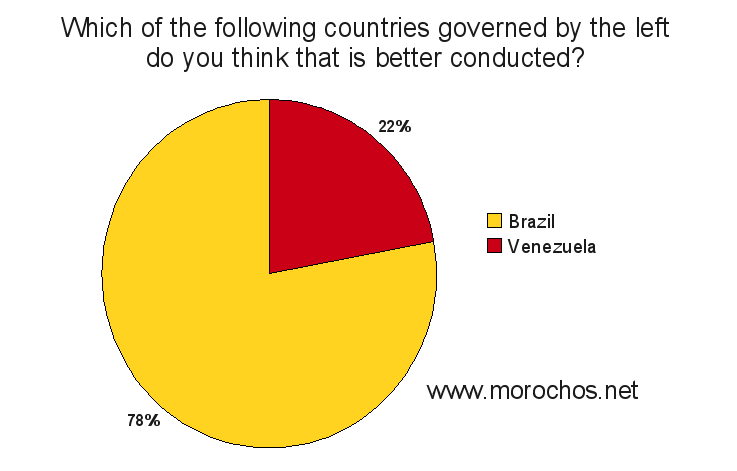
During June 2009, we made the following question to the visitors of our Spanish website Morochos.org:

Which of the following countries governed by the left do you think that is better conducted?

We gave two options and each received the following percentage of votes:

1) Brazil, 78%

2) Venezuela, 22%

Observations:

Brazil and Venezuela represent the two political models among which the Latin American left is divided. On one side we have Chavez with his "twenty-first century socialism", which is merely a revival of the socialist system, human rights violator, that Fidel Castro established in Cuba with the help of the Soviets. On the other side is Lula, a more sophisticated leftist that, in addition to assimilate the basic rules of democracy, is aware that the Cuban socialist system has too many flaws to be considered a reasonable project.

From the first moment the answer to this survey would seem obvious, in fact almost any government in the world is better guided than the Chavez regime in Venezuela. However, despite the clear preference for the Lula government, Chavez has some imitators in the region. But anyway, there is nothing new to find disoriented politicians everywhere, especially if we talk about Latin America.

Click on the image to enlarge it


Related articles:

- Focus Group: The opposition and Chavez's radicalism in 2009

- Obama-Lula meeting, March 2009: Brazilian energy

- Why Castro and Chavez mellowed down their tone against Obama

Monday, July 20, 2009

If Zelaya returned to power...

Authors:
José Alberto López Rafaschieri and Luis Alberto López Rafaschieri
www.morochos.net

If Manuel Zelaya returned to the presidency of Honduras, that country would go through something similar to what Venezuela experienced after Chavez returned when he was removed from power in 2002. That is, Honduras would enter in a process of political confrontation in which the Zelayistas' revenge would be the slogan of the government.

With the help of Chavez and the Cuban dictatorship, if Zelaya returned to govern Honduras he would start a witch hunt to imprison all those who had some responsibility for his removal, would initiate a purge within the Honduran armed forces to remove the suspects, and would begin a relentless persecution of government dissenters with the excuse that all opponents were involved in the coup, which would facilitate that Zelaya completes the Chavez plan to make the Honduran political system a copy of the Castro-Chavez model.

So at the end, if Zelaya returns to power, Honduras would become a country completely divided and unstable. Hence the return of Zelaya, although is supported by the international community, is very far from being a solution to the current political crisis in Honduras.


Related articles:

- Coup if it is rightist, revolution if it is leftist

- Most Hondurans justify the removal of Zelaya

- Chavez's and Insulza's plan for Honduras is wrong